The Impact of COVID-19 on Education
- Holly Busby
.jpg/v1/fill/w_320,h_320/file.jpg)
- Jan 21, 2021
- 3 min read
Updated: Jan 22, 2021
Online teaching, cancellation of exams is impacting the quality of education and its effect on young people.
On the 4th January, the Prime Minister announced once again that GCSE and A Level examinations in the Summer of 2021 will ‘not go ahead as normal’ and that schools would close.


Picture by Andrew Parsons (CC BY-NC-ND 2.0)
Instead of examinations, grades will be based on teacher/classroom assessments and not adjusted by an algorithm like in the Summer of 2020.
The Welsh government cancelled GCSEs and A-Level exams in November. Education Minister Kirsty Williams said it was impossible to guarantee a level playing field for exams due to the ongoing impact of the pandemic.
Young People’s Mental Health
These institutions of learning play an important role in supporting young people and for many provide the only place for social interaction.

In June 2020, the Young Minds Survey showed that:
“74% of teachers and school staff agreed that schools being closed to most students over the period of lockdown has had a negative impact on the mental health of young people.”
There is evidence showing that quarantined students tend to spend less time in learning compared to when schools are open.
Many students confined at home due to COVID-19 may feel stressed and anxious, and this may negatively affect their ability to concentrate on schoolwork.
Physical school closure and the lack of in-person contact may make students less externally motivated to engage in learning activities.
Experience in the Field
Katie Sloane, Mental Health Nurse and CBT Therapist, said that she was concerned for young people’s mental health as she has noticed an increase in young people seeking mental health advice.
Having to go to school teaches children the act of getting up and ready in the mornings in preparation for school, which helps in later life getting up for work.
Because teaching has been moved online, children do not have to get dressed or even get out of bed as they just need their laptop to log on to the teaching, during which they don’t need to listen or engage if they don’t want to.
Katie Sloane goes on to say, “Young people are experiencing a lot of anxiety about what the future holds. They are missing out on crucial life skills that are exposed to us at school.”
She worries that COVID-19 will have a negative impact on society as young people won’t grow up with good communication skills and be a lot more withdrawn causing less to go to University to get better jobs later in life.
In young people that struggled already with anxieties to do with school, before the pandemic, will now never have to deal with their insecurities causing a lack of improvement.
University Students
The higher education sector has been affected by COVID-19 immensely and has been stated that it will have possible long-lasting effects.
Students have been made to switch to online learning meaning in some cases, assessments and dissertations have had to be drastically adapted to be done online or been stopped completely.
Many students feel they are not receiving enough support from the university and 35% are not satisfied overall.

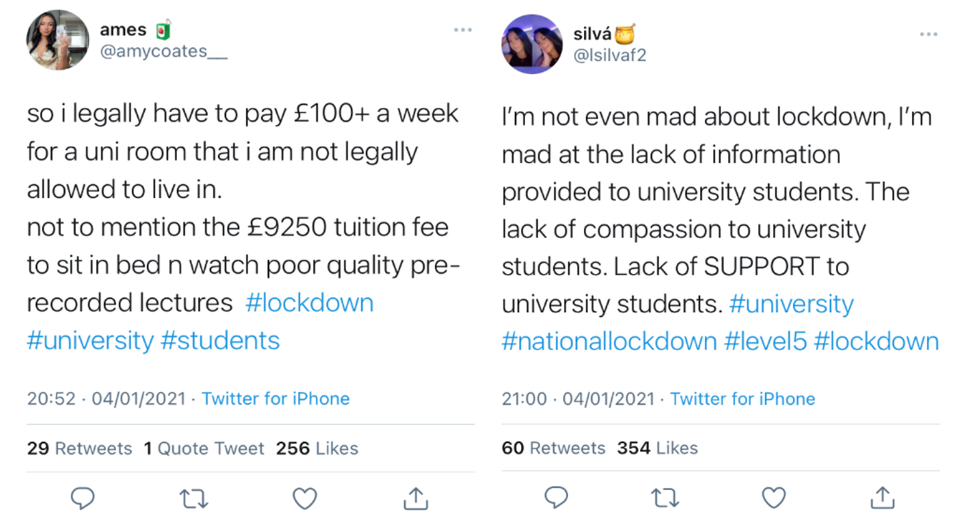
Pictures by @amycoates__ and @lsilvaf2 via @Twitter
Ellie Parker, a pharmacy student at the University of Birmingham, says the fact she is unable to go to the gym to exercise is one of the causes for her mental health deteriorating due to exercising causing the release of serotonin.
She talks about her experiences as a final year student being ‘ruined’ and is disappointed in the governments neglect of higher education students. She goes on to say:
“I think they’ve done a lot of people dirty because they’ve restricted people’s movement on where they can and can’t live, but not helped them out financially. The government should’ve made sure universities did better for their students, but in every aspect.”


Picture by me of University of Birmingham Sport and Fitness Centre
She says the government should have made sure universities were helping students such as with:
· Mental health
· Financially
· Quality of teaching
The Sutton Trust reported 34% of students had since lost a job, had reduced hours or not been paid for work completed, however the same students are still being expected to pay full tuition fees for online teaching. For many, they are also having to pay accommodation costs, whether they can live there or not.
Future Students
It has estimated by the consultancy London Economics that 17% of prospective UK students would not enrol in September if coronavirus restrictions remained, causing a £763million loss in tuition fees and teaching grants.
Hannah Benson says, “I had plans to start university this September, but I didn’t bother applying as I don’t want to face the same struggles other students have faced.”
This will have long-lasting effects in society as there will be less people working in skilled jobs such as Pharmacy and Medicine as people will be less likely to be going to do those things at university now.
By Holly Busby

Comments